01 — Foundation
Foundations in Texture
12 weeks · Full time
Tuition on application
For those beginning. A ground-up study of coily, curly and straight hair — its chemistry, its history and its handling.

Academy
Small cohorts. Long hours. A slow, honest apprenticeship in the practice of hair — taught in Nottingham by the stylists who work our chairs, from the fibre outward.

Where
26 Peveril Street, Radford
Cohorts
Small, by application
Taught by
Working members of the house
Next intake
Confirmed on enquiry
We do not manufacture stylists. We form artisans — one small class at a time — in a room that treats hair as a living material.
Every programme is taught by working members of our house. What you learn on Monday you may practise in a chair by Friday.
Every programme covers the same ground at a different depth. It is the salon's own work, taught in the order a pair of hands actually learns it — technique first, taste after.
Fibre before fashion. Porosity, density and curl pattern; the scalp read as skin; how a head of hair behaves once it is wet, warm, tensioned or tired.
Knotless, box and goddess braids. Cornrows and stitch rows laid close to the scalp, twists, plaits, crochet, and the cornrow foundation a weave is built on.
Starting and sectioning, retwist and interlocking, barrel and two-strand twists, repair work, detox and the rinse and steam that settle it all down.
Silk press and curly perm. Relaxer strength, timing and the discipline to stop. Bleach and tone — and the patch and strand tests that come before either.
Conditioner, clay, charcoal and keratin work. Reading damage honestly, and learning the harder skill: knowing when the right answer is to do less.
How to read a head of hair, quote it fairly, plan aftercare, and hold the chair for a child or a first-time client with exactly the same care.
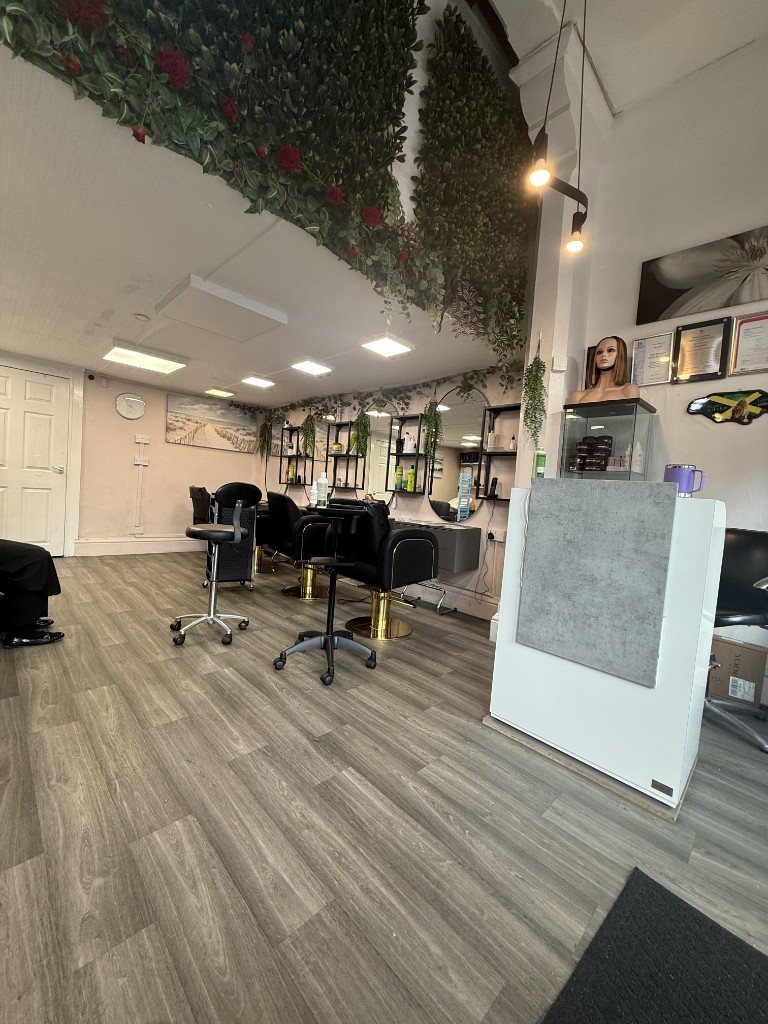
Technique is drilled on mannequins until the hands stop thinking about it, then it moves to model clients — supervised, at a real basin, with real time to keep. Nothing is taught in theory that isn't practised the same week.
Cohorts stay small because correction has to be personal. You will be watched closely, told plainly what is wrong, and shown again.
Durations describe the shape of each programme. Current tuition, start dates and kit are confirmed in writing when you enquire — write to us for the figures as they stand today.
12 weeks · Full time
Tuition on application
For those beginning. A ground-up study of coily, curly and straight hair — its chemistry, its history and its handling.
8 weeks · Part time
Tuition on application
Hand-painted balayage, tonal work, and the confidence to consult on any complexion.
6 months · In-studio
Tuition on application
A paid apprenticeship at the chair of a house master. Selective. Rigorous. Transformative.
No experience, no kit, no salon behind you. Foundations assumes only that you are willing to put the hours in.
Already behind a chair, and tired of turning away the one thing you never learned — colour, locs, or a cleaner cornrow.
Coming from another trade entirely. Part-time study exists so a programme can sit beside a job you can't yet leave.
Anything not answered here, ask us directly — we answer every note ourselves, usually within a working day.
Not for Foundations — it is built for people who have never sectioned a head. Colour Mastery expects you to be working already, or recently trained.
All of them — coily, curly, wavy and straight — with Afro-textured hair as the starting point rather than a module bolted on at the end.
In the house itself, at 26 Peveril Street, Radford NG7 4AL. You learn in the same room the salon works in, at the same basins.
Both are confirmed in writing when you enquire — tuition and dates move with the programme and the room, and we would rather quote you honestly than post a number that has drifted.
Ask us plainly when you write and we will answer plainly — what a given programme awards, and what it doesn't. We would rather be useful than impressive.
Bring nothing to the first conversation. If a programme is right for you, we send a list of what it needs before you commit to anything.

We meet each applicant personally. A short portfolio and a conversation are all that is required to begin.
Write to us
A short note is enough: what your hands can already do, and what you want them to be able to do.
A conversation
In the house where possible, by phone where it isn't. Bring a portfolio if you have one — photographs on your phone count.
Your place
If it is a fit, we confirm tuition, dates and what to bring in writing, before you commit to anything.
Or call the Peveril Street house on 07855 054241.